
UnConference
How can we accelerate towards a fair and sustainable future?


Recently, I attended the 2023 edition of Chatham House’s Sustainability Accelerator UnConference. The theme this year was: how can we accelerate towards a fair and sustainable future?
This marked the third time that Chatham House has hosted the event. Ben Yeoh, a colleague, is one of the organisers and it was through his newsletter that I originally heard about the event.
When the premise of an ‘UnConference’ was first explained to me, I was highly sceptical about the format. It seemed almost ludicrous to me that anyone could hope to run a conference in such an unstructured way.
Now, having experienced the UnConference two years in a row, I simply cannot understate how impressed I am by this event format as a means for meeting and sharing ideas with others.
In this post, I would like to share some takeaways and learnings.
Traditional Conferences
A typical, traditional conference generally offers a pre-set agenda, named speakers, and invites the audience to be passive listeners. There may be networking breaks in between sessions or at the end of the day, but these are subsidiary to the main purpose of the event, which is to attend the talks, perhaps with the opportunity to ask questions of the presenters.
I have attended plenty of conferences in this traditional format. In my experience, many of the most stimulating discussions take place not during the conference presentations themselves, but rather during the breaks between presentations when attendees can engage with one another and discuss topics in a more informal manner, while expanding their own professional networks.
Likewise, I often find that, as a passive listener, my ability to engage and learn from the speakers is fairly limited. There is only so much information I can absorb passively from a speaker with a PowerPoint before I reach a saturation point.
What is an UnConference?
By contrast, an UnConference invites all attendees to participate actively and places an emphasis on facilitating informal networking interactions.
At the start of the day, all participants gather together in a large circle and the facilitators share the guiding principles of the day:
Whoever comes are the right people.
Wherever it happens is the right place.
Whatever happens is the only thing that could have.
Whenever it starts is the right time.
When it is over, it is over.
Besides these principles, there is one important rule of thumb called The Law of Two Feet or The Law of Mobility. This rule states that, if you find yourself bored, not learning or not contributing, use your mobility to take yourself where your time is better spent. I have found this to be a genuinely empowering piece of advice, aided by the prominence it is given at the start of the day.
As a result of this rule, you often see bumblebees, people who go from group to group spreading and connecting ideas, or butterflies, those who hang out, daydreaming or gossiping between groups. All this collective activity adds up to a system of self-organisation that can be highly creative and effective at dealing with issues in an efficient way.
After these principles have been established, the facilitators invite any participant to enter the centre of the circle where they can announce a topic that they would like to discuss that day. Once a participant has announced their theme, they are invited to schedule a session on the timetable so that they can work on it during the day. Throughout the day there are four time slots, but within those slots there can be multiple sessions.
In this way, every participant is encouraged to propose topics, facilitate discussions, and contribute to conversations in a meaningful way. In my experience, generally somewhere between 30-50% of participants propose topics and facilitate discussions. If an individual has called a session, they are expected to attend their own session, but they do not have to be an expert on the topic or even an active participant. If they wish, they can simply listen.
Once all the topics are timetabled, participants head over to the timetable, now filled with proposed topics, and they choose which sessions they want to attend. Then, everyone gets to work on the things that they feel most passionate about. Typically, this results in small, flexible break-out groups.
Chatham House, Sustainability UnConference 2023
As mentioned above, the over-arching theme set by the organisers for the event this year was: how can we accelerate towards a fair and sustainable future?
Below, I have complied a list of all the titles of the sessions that were called by participants. In bold, I have highlighted the sessions that I personally attended.
When the sessions are on such engaging themes, it can be very difficult to decide which discussions to attend. Helpfully, the organisers always ask each group to take notes during their session. These notes are then compiled together to produce a report. Here is the report for the 2021 UnConference.
I chose to facilitate a discussion titled ‘creating liveable cities’ and I was the note-taker for the session on ‘trains vs. planes’.
I’ll share those notes on trains vs. planes next time.
Session Slot 1 (10am-11am)
Circular economy and the ministry of defence
Neurodiversity: a way to get there faster
Socialising water
Spreading the word by listening
Government as systemic investor
Equitable ownership
What is responsibility?
How do we prioritise ‘good’
What does double materiality mean?
Consumerism
Session Slot 2 (11am-12pm)
Trains vs. planes
Decarbonising whole communities
Philosophy: Concepts vs experience
Humanity and artificial intelligence
Biodiversity markets, is nature the new gold
Purpose and profit, possible?
Boardroom mindsets
EVs, the answer of the problem
Systemic change as carbon offsetting
ESG for institutional investors
Religion and environmental responsibility
Effective acceleration
Tell me the story of when you started to care about sustainability
Session Slot 3 (1pm-2pm)
Global food (in)security
What do you mean by a fair and sustainable future
Communicating complex ideas simply
Education + Awareness + lifecycle equals efficient
Engage and/or divest
The value of nature
Green skills and green jobs
Progress vis consensus or legal imposition
Open abattoirs and animal burning with fossil fuel
AI for for social good how can data tech help
Indigenous communities and the sustainable transition
Session Slot 4 (3pm-4pm)
Creating liveable cities
ESG ratings
Emission reduction vs emission removal
Infrastructure in the era of climate change
How to unlearn in order to learn
What should the next UK government do?
Why don’t people know what is in their pensions?
So, there you go! That is what an UnConference can look like. If you get a chance to attend one, I highly recommend it.
Thank you for reading. As always, feel free to reply if you have comments, questions or suggestions.
Postscript: The Book of Changes
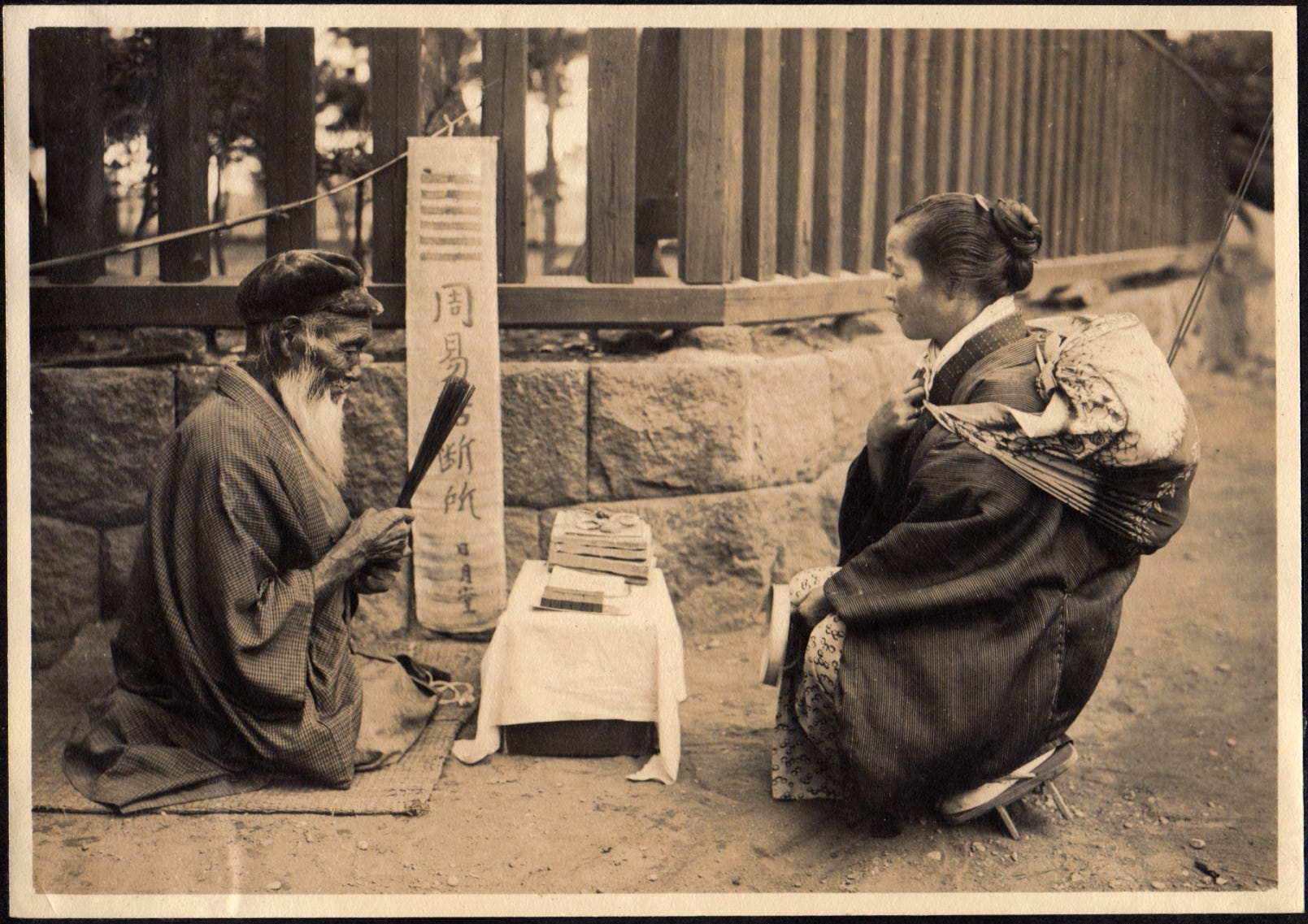
During the conference’s lunch hour, I headed out into the green space at the centre of St James Square. There, I discovered that one of the participants was offering to facilitate I Ching readings.
Unbeknownst to me prior to this encounter, the I Ching, in Mandarin 易經, usually translated as The Book of Changes, is an ancient Chinese text, dating to roughly 1000 BC. The text offers a series allegorical divinations categorised according to hexagrams.
The rough idea here is that, you pose a question to yourself, usually some sort of dilemma or significant question about your life. Then, you produce a hexagram (a figure consisting of six stacked lines) via some method (such as tossing coins, drawing dice, or dropping sticks). Once the hexagram is produced, you use an index to identify which passage of the I Ching corresponds to your hexagram. Finally, you consult the text, which offers you some sort of interpretation of your question and provides insight or guidance into the situation at hand.
Now look, I am generally sceptical about most belief systems and I think that taking advice from an ancient book is not a rational or reasonable course of action. Cleromancy, bibliomancy, or any other method of fortune-telling is unlikely to be a prudent way in which to make important life decisions. What is more, the text of the I Ching is written in poetic language that is often allegorical or symbolic such that it can be open to a variety of interpretations.
That said, I went ahead and tried it anyway. In doing so, I found it to be a genuinely constructive exercise. I posed my question and consulted the text. On reading the interpretation offered by the text, I found that my response to the allegory helped me determine what I actually thought about the question. It did not literally provide me with an answer, but it did compel me to reach my own conclusion and discover what I actually felt about that question within myself.
.jpg)
Bibliography
UnConference Facilitator: Improbable
Ben Yeoh: