
City Bridge Foundation
Has London's charity for bridges abandoned bridges?

We could fund public transport on Hammersmith Bridge today for just £10 million, this piece explains how.
My prior post outlined the political gridlock around Hammersmith Bridge. That post has now been read by 20,000 people and may have helped reignite interest in the bridge. For the first time in many years, the Bridge has seen protests involving hundreds of local residents, national news articles, and lobby group campaigning.
In summary, Hammersmith Bridge is now open to pedestrians, cyclists, and wheelchair users but has been closed to motor vehicles for almost seven years. The local council, the bridge’s owner, has spent at least £50 million on repairs. The current proposed long-term solution costs around £300 million, yet it would appear that the council has not formally considered public transport alternatives, not least the most viable solution (autonomous electric shuttle pods costing just £10 million).
The council itself seemingly has limited remaining reserves. Neither the Government nor the Mayor of London has stepped up to solve the issue.
But what if London had a charitable endowment with £1.6 billion specifically established to maintain bridges?

The City Bridge Foundation
London has precisely that: the City Bridge Foundation.
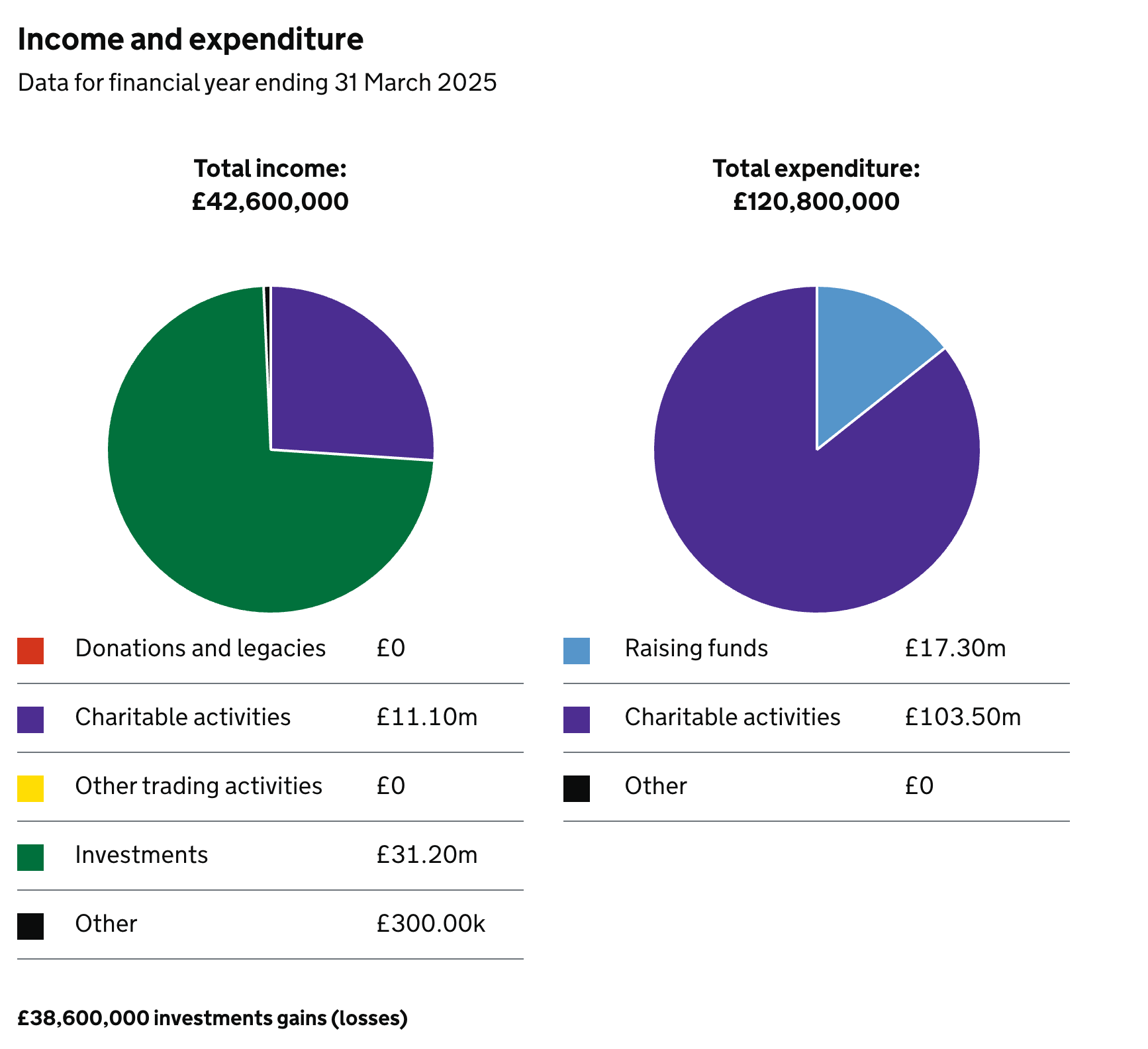
Founded 1,000 years ago specifically for the maintenance of bridges in London, it has amassed a £1.6 billion endowment through tolls, donations, and investments. Now, it generates around £45 million annually.
But today the charity seems to be spending its endowment primarily on social justice causes rather than bridges.
In 1176, after a wooden London Bridge collapsed, Londoners established a fund to build and maintain a permanent stone river crossing.
Today, the Foundation maintains five bridges, all adjoining the City of London. It has twice rebuilt London Bridge (1831, 1973). Later, it constructed Blackfriars Bridge (1869) and Tower Bridge (1894), purchased Southwark Bridge (1868) from its private toll company. Most recently, it funded and then assumed responsibility for the Millennium Bridge (2000).
By the 1990s, through centuries of good stewardship and property accumulation, the endowment could generate far more income than bridge maintenance required. In 1995, the Charity Commission authorised a cy-près scheme permitting surplus funds to be spent on broader charitable purposes.
The primary objective remained the maintenance and support of the five bridges, but the governing document now also stated that surplus income could be applied as follows:
First: “In or towards the provision of transport and access to it for elderly or disabled people in the Greater London area.”
Second: “For other charitable purposes for the general benefit of the inhabitants of Greater London.”1
Since 1995, the Foundation has awarded over £840m to charities.
More specifically, in the last decade (2015-2025), an estimate based on publicly available data suggests that the Foundation has spent money approximately as follows:2
87% (£520m) on non-bridge grants.
10% (£50-60m) on bridge maintenance.
3% (£20-30m) on Tower Bridge operations.
From bridges to social justice
How did a bridge charity spend £520m without funding bridges?
Simple: The charity has refocused its grant-giving to social justice causes. According to its own website, its most recent funding policy has four grant themes: “Climate Justice, Access to Justice, Racial Justice, and Economic Justice.”
The Foundation’s own reporting shows the shift. Here’s a snapshot of grants awarded over a six-month period in 2023:
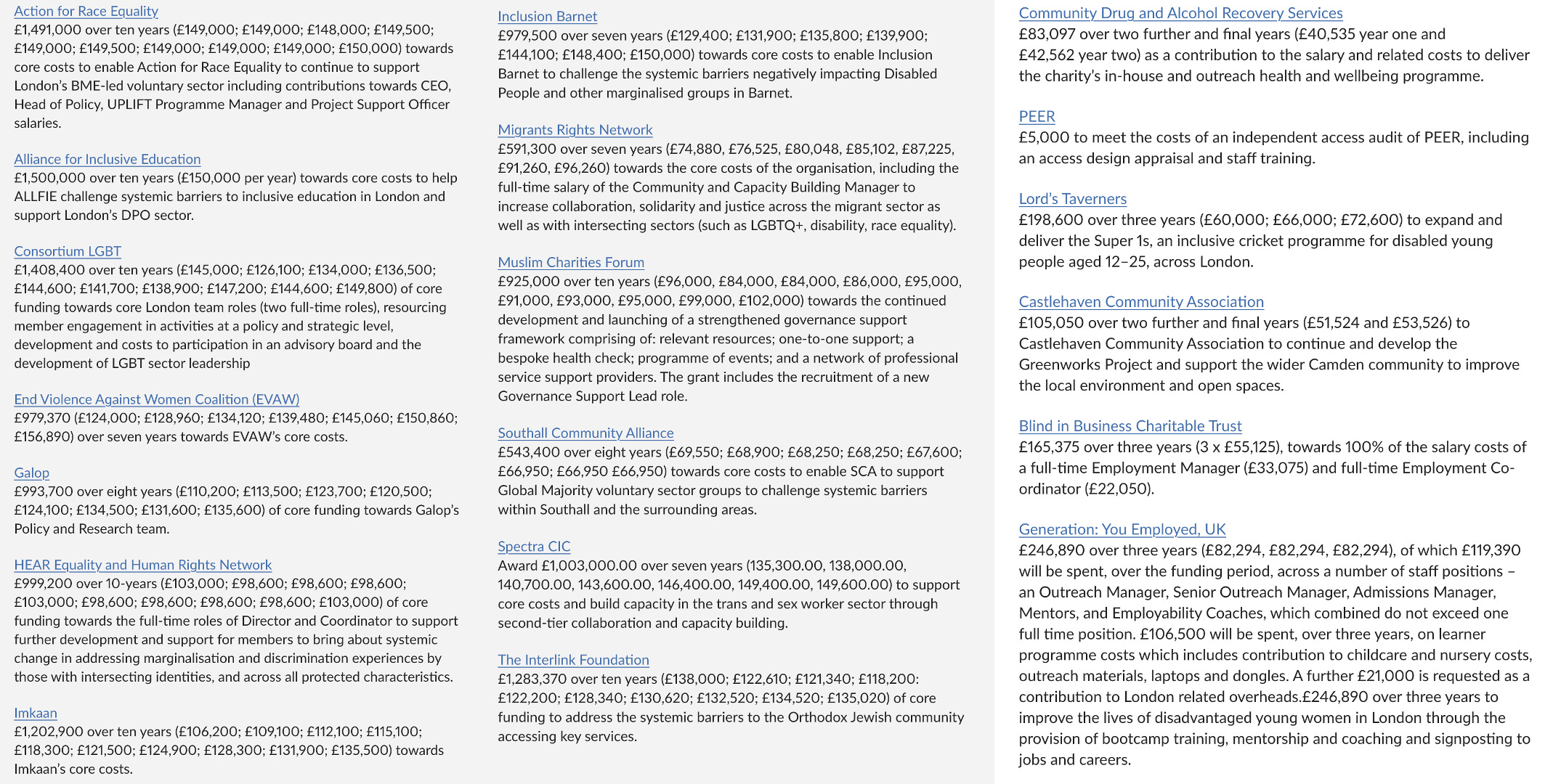
Notably absent from the Foundation’s grants: any funding for bridges or transport for elderly and disabled people.
And yet, they even have a poet-in-residence. In fact, City Bridge Foundation have funded a charity that opposed the construction of a new Thames river crossing!3
Meanwhile, London’s bridges decay. Hammersmith Bridge has been closed to motor vehicles for seven years. Albert Bridge is unable to carry buses. Vauxhall Bridge is approaching its end-of-life. Likewise, half a dozen other Thames crossings require urgent investment.
The 1995 scheme listed transport for elderly and disabled people first, general charitable purposes second. In practice, the Foundation funds almost exclusively the latter whilst deprioritising the former.

The perfect grant: £10m for Hammersmith Bridge
Here is a proposed grant that might align more closely with the stated charitable objectives of the Foundation.
The City Bridge Foundation could fund autonomous electric shuttles across Hammersmith Bridge: £10m to restore transport for elderly and disabled Londoners, just one eighth of the Foundation's annual grant expenditure last year.
Importantly, the Foundation’s policy states it will not fund projects that relieve statutory bodies of their duties. That is entirely reasonable: the charity cannot assume responsibility for every bridge in London, nor should it transfer what could be substantial ongoing liabilities onto its balance sheet.
But surely public transport for Hammersmith Bridge falls squarely within the Foundation’s charitable objectives?
First, this is not relieving a statutory duty. The council’s statutory duty is highway maintenance, not public transport provision. The council has spent £50m on structural repairs with no remaining budget. An autonomous shuttle would be additional transport infrastructure, not a substitute for highway obligations.
More fundamentally, the project directly fulfils the 1995 scheme’s charitable object: “provision of transport and access to it for elderly or disabled people in the Greater London area.” The pods would provide accessible transport for elderly and disabled residents currently cut off from essential services, operating between Hammersmith & Fulham and Richmond, and re-connect key public transport nodes.
This project falls neatly within the scope of the charity’s objective: providing a charitable benefit where statutory provision cannot extend.
Implemented well, autonomous shuttles could operate on a commercial basis with fare revenue offsetting operational costs, potentially even generating surplus income whilst demonstrating innovative infrastructure solutions that might be replicated across London.
Another thousand years of London bridges?
There are a multiplicity of charities for social justice causes. There is only one charity for London’s bridges.
The City Bridge Foundation exists because medieval Londoners understood infrastructure as an intergenerational obligation. They built bridges not for themselves but for their descendants.
Will we honour the legacy of prior generations by restoring public transport access across Hammersmith Bridge for elderly and disabled Londoners?
The Foundation could act for the benefit of all Londoners by funding a grant for public transport provision on Hammersmith Bridge.
Today, the charity has the opportunity to return to its core objective envisaged by the generations of Londoners who built the endowment, rather than evolving into a generic philanthropic endeavour.
Many thanks to John Murphy and Joe Hill for highlighting to me key information that inspired and informed this piece. You can read John’s CityAM piece here and Joe’s piece here.
Special thanks also to Ludo for reviewing the drafts and being a steadfast friend.
Disclaimers: For the avoidance of doubt, this article does not (and is not intended to) imply or suggest any potential mismanagement or maladministration of any kind whatsoever regarding the governance, operations or administration of the City Bridge Foundation (charity number: 1035628, formerly Bridge House Estates) or by any of the trustees, employees, advisers or any other individuals or entities.
The author writes in a personal capacity and all views expressed are his own. The information in this article is drawn exclusively from sources available in the public domain including the Charity Commission’s published register and records, the City of London Corporation publications, and the Foundation’s own published materials.
Source: Governing Document, The Charities (The Bridge House Estates) Order 1995, SI 1995/1047. The area of benefit defined as “London Bridge, Blackfriars Bridge, Southwark Bridge, Tower Bridge, the Millennium Bridge and Greater London.”
Source: City Bridge Foundation Annual Reports and accounts 2015-2025, available via Charity Commission Register No. 1035628. 360Giving grant database.
Source: John Murphy writing in CityAM:
“In 2023, CBF gave a grant via Propel to the charity Queercircle, perhaps unaware of its recent backing for a campaign against the latest Thames crossing. In 2022, alongside an exhibition called Tunnel Visions, Queercircle collaborated with Stop the Silvertown Tunnel Coalition, a Nimby group, on a series of workshops and events. The coalition was originally set up to oppose the Silvertown project, and in 2022 it was still lobbying to stop cars and heavy goods vehicles from using the tunnel. Queercircle was reported as helping “empower local people to take action”